Season4-Episode10은 2018년에 발생하여 많은 사람들이 사고 소식을 보도 매체를 통해 직접 접했던 비극적 참사인 Viadotto Polcevera(일명 Ponte Morandi) 붕괴를 소개한다.
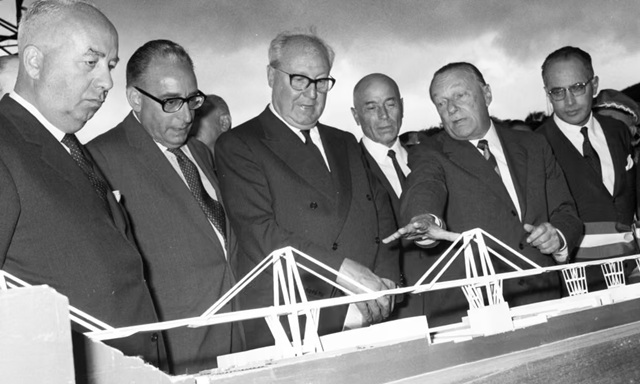
사고 교량은 이탈리아 리카르도 모란디(Riccardo Morandi) 교수(우측에서 두번째 사람)가 창안한 Concrete Cable-Stayed Bridge 형식으로 1960년 초부터 이탈리아를 중심으로 세계 곳곳에 적용되었느나, 현재는 거의 사용되지 않는 구조 형식이다. 멀리 갈 것 없이, 1992년 시공 중 붕괴된 신행주대교가 바로 이 형식을 채택한 교량인데, 모란디의 설계 concept이 얼마나 직접적으로 반영되었는지에 대해서는 설계도서를 볼 수 없어 확인할 수 없지만, 사고조사위원으로 참여했던 김생빈 교수의 최종보고서(1992)에 “프리스트레스에 의한 콘크리트 사장재 공법을 도입하면서 대부분 외국 기술진에 의존했고, 공사 과정에 대한 전문 지식 부족이 붕괴의 간접적 원인이 되었다”고 언급한 것을 보면 그 연관성을 명확히 알 수 있다.
모란디 교수가 강재 케이블을 콘크리트로 감싸는 방식을 만든 배경에는 명확한 공학적 의도가 있었다. 그는 1968년 스페인 학술지(Informes de la Construcción)를 통해, 강재 케이블 주위에 프리스트레스가 도입된 콘크리트 외피를 형성하여 케이블과 외피를 일체화(homogenization)함으로써, 외피의 균열을 억제하여 강재를 보호하고, 케이블의 응력 변동과 신장을 감소시켜 피로 안전성을 높이며, 구조물의 회전과 변위를 줄일 수 있다고 설명했다. 정확한 내용은 원문이 스페인어라 영문 번역본을 인용한다.
As is quite evident, the main advantages of the homogenization process can be summarized as follows:
1) elimination of cracking in the sheaths, thereby preventing potential damage to the steel from atmospheric agents and avoiding structural damage (콘크리트 피복의 균열을 제거함으로써, 대기 작용에 의해 강재가 손상될 가능성이 제거)
2) reduction of the amplitude of the stress variation range in the steel, with the consequent increase in safety against fatigue due to cyclic stresses (강재에 작용하는 응력 변동 범위가 감소하여, 반복 응력에 의한 피로 안전성이 향상)
3) reduction of frame rotations at the supports over the oblique struts, due to the decreased elongation of the stay-tenders under accidental loads (활하중 작용 시 케이블의 신장이 감소함에 따라, 경사 지지부에서의 구조계 회전이 감소)
4) reduction of the longitudinal horizontal displacements of the antenna system’s crest, due to the asymmetric distribution of accidental overloads (활하중의 비대칭 분포에 의해 발생하는 안테나(주탑) 상부의 종방향 수평 변위가 감소)
*원문에서의 cargas accidentales, sobrecargas accidentales이 각각 accidental loads와 accidental overloads, 즉 우발하중으로 번역되나 일반적으로 활하중을 지칭하며, puntales oblicuos는 oblique struts이며 모란디 교량 특유의 V자형 경사 교각
특히 경제성 측면에서는 이 교량이 유사한 조건의 일반 강재 케이블 사장교보다 강재 사용량을 약 1/3 수준으로 획기적으로 줄였다고 강조했다. 하지만 역설적이게도, 당시 그가 자신했던 ‘강재를 보호하는 콘크리트 갑옷’과 절제된 사장재를 통한 ‘극도의 경제성’은 수십 년 뒤 내부 부식을 은폐하고 redundancy를 부족하게 만드는 비극의 씨앗이 되고 말았다.
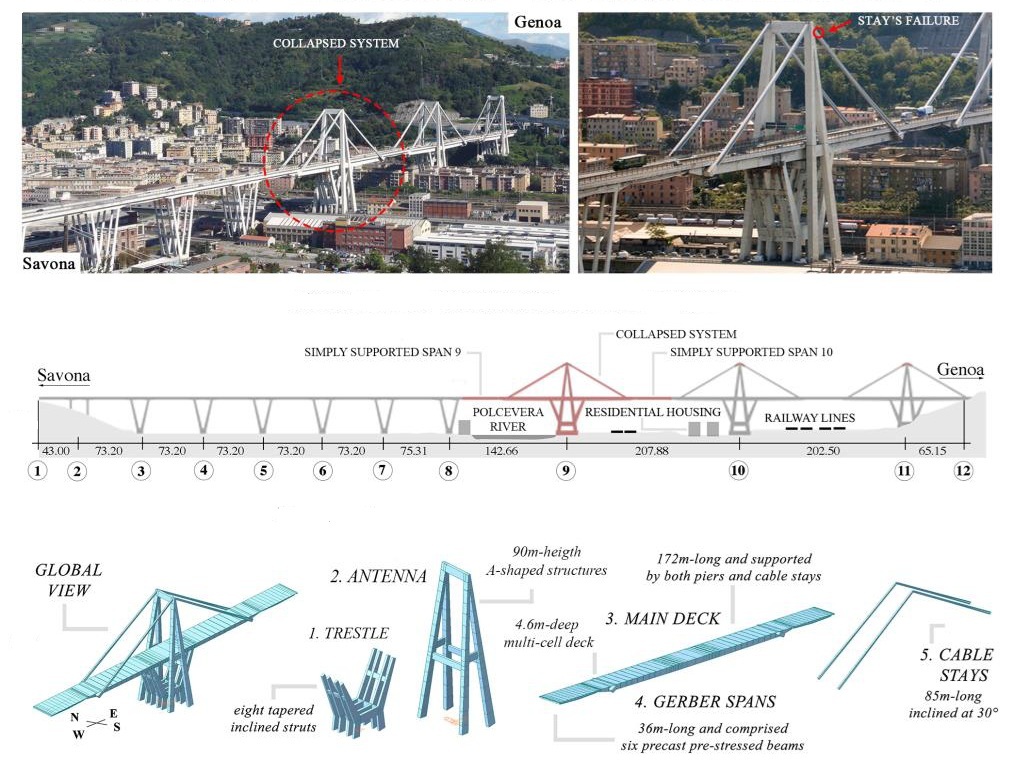
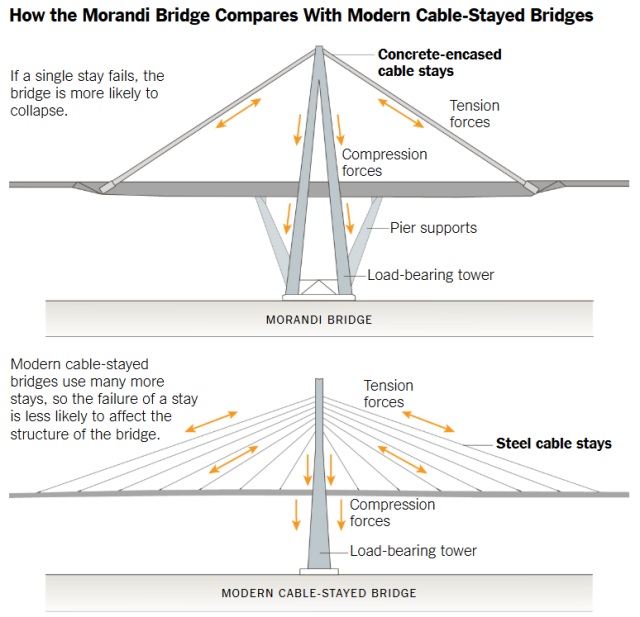
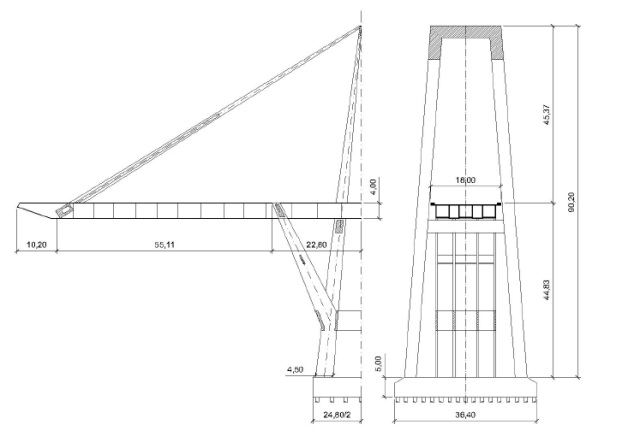
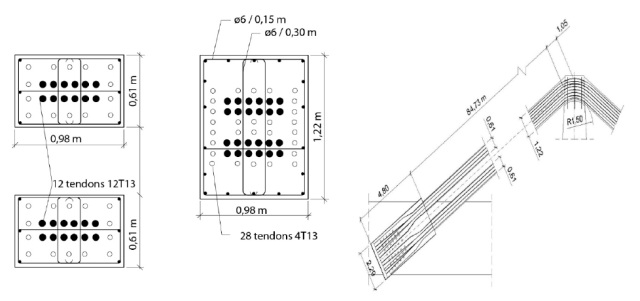
사고원인에 대한 공식보고서가 있으나 자료양이 많고 이탈리아어로 되어 있어 다른 영문자료를 검색해 보니 이 글(Causes of the Collapse of the Polcevera Viaduct in Genoa, Italy)이 요약을 잘 해 놓았다. 이 글에 나와 있는 내용을 바탕으로 사고 원인을 정리하면 아래와 같으며, 이로 인해 프리스트레스 손실 및 콘크리트 균열 발생 -> 균열을 통한 습기 침투로 내부 강재 케이블 부식 -> 케이블 장력 손실 -> 케이블 파단 및 교량 붕괴라는 redundancy가 없는 교량들의 붕괴 메카니즘을 따른다.
- 직접적인 붕괴 원인
Cause of the viaduct collapse was the rupture of one of the stay cables at support No. 9 holding the cantilever from the side of the multi-span overpass. - 재료적 원인(Material Cause)
Reduction of the pre-stressing force overtime and the deformation of the diagonal stay cable resulted in cracking of the concrete cover. The cracked cover was not a suitable anti-corrosion protection for the tendons, which under these conditions were subject to accelerated corrosion. - 구조적 원인(Structural Cause)
– Design solution adopted by Prof. Morandi that only two structural components supported the cantilever with the suspended span, excludes any cooperation of these structural components in a situation where one of them is destroyed or damaged
– Cantilever length of approximately 65 m is too large
– Concrete cross-section of the pylon is too small for the cross-section of the diagonal stay cables attached to the pylon
– Assessment of the technical condition of steel tendons inside the concrete element is very difficult in practice, especially the assessment on the peak of the pylon at the height of 45 m above the deck level - 조직적 원인(Organizational Cause)
Only diagonal stay cables at support No. 11 were strengthened, and no attempt was made to strengthen the diagonal stay cables at support No. 9 (참고로, 1990년대 초반 이미 케이블 부식 문제가 심각하게 제기되어 11번 교각은 보강 공사를 마쳤으나, 붕괴된 9번 교각은 보강작업을 미루고 있었음)
붕괴과정을 그래픽으로 잘 정리한 자료가 Genoa Bridge Collapse: The Road to Tragedy에 있어 과정을 캡쳐했다.
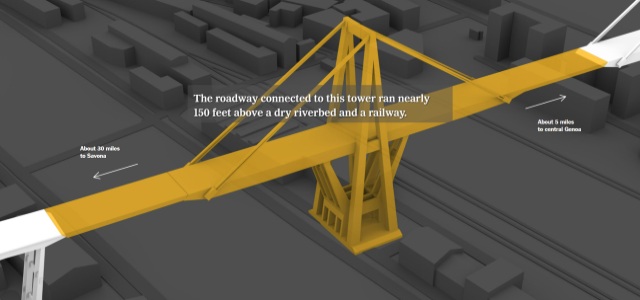
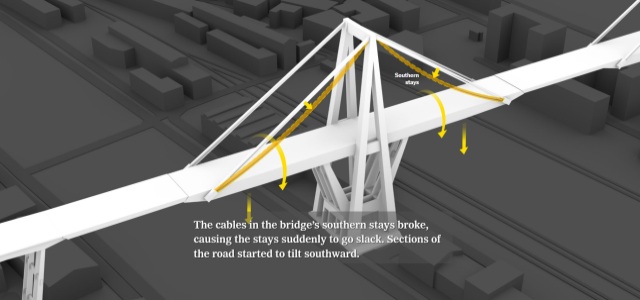
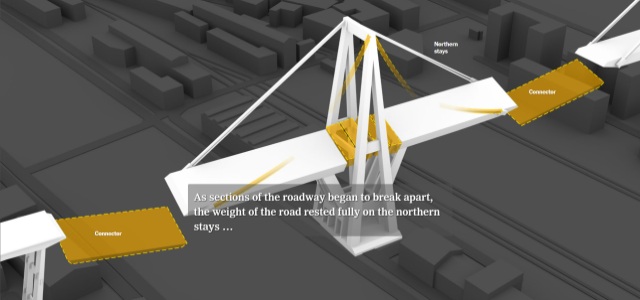
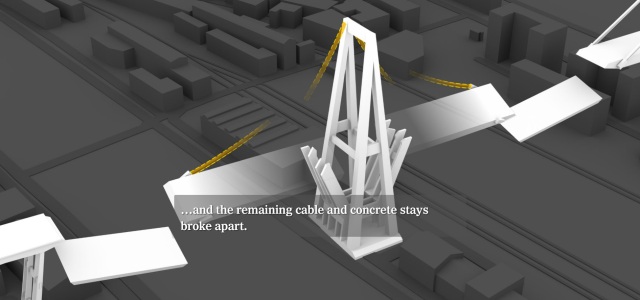
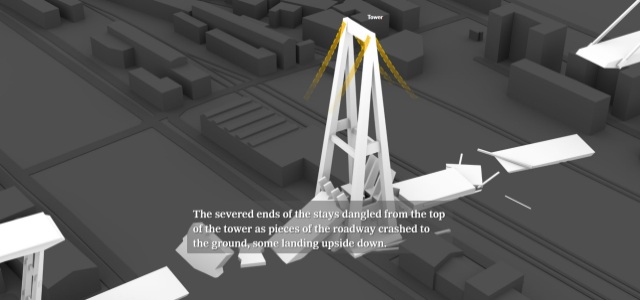
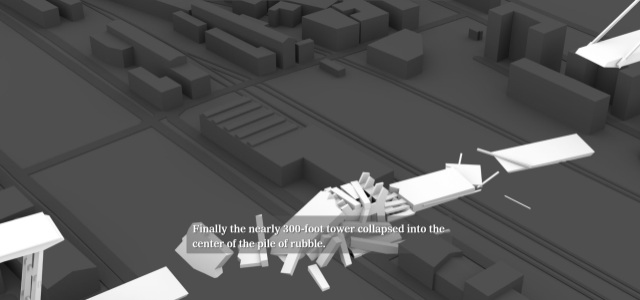
이 교량의 붕괴는 단순한 유지관리 실패나 국부적인 결함이 아니라, 모란디 교수가 의도했던 개념 자체가 장기적인 관점에서 어떻게 다른 결과를 낳을 수 있는지를 보여주는 사례라 할 수 있다. 강재를 외부 환경으로부터 차단하기 위해 도입된 콘크리트 피복은 오히려 내부 상태를 확인하기 어렵게 만들었고, 제한된 사장재 구성은 하나의 부재 손상이 곧 전체 구조계의 붕괴로 이어지는 취약한 시스템을 형성하였다. 이는 설계 단계에서의 경제성과 단순화가 장기적인 유지관리나 안전성 확보와 항상 양립하는 것은 아니라는 사실을 보여준다.
구조물의 안전성은 단순한 강도 설계에만 국한되지 않는다. 점검이 얼마나 용이한지(inspectability), 일부 손상이 발생하더라도 구조가 이를 견딜 수 있는지(damage tolerance), 그리고 하중을 분산시킬 수 있는 대체 경로가 확보되어 있는지(redundancy)까지 함께 고려되어야 하는 개념이다.
모란디 교수는 본인이 창안한 교량의 미적 가치를 단순함(simplicity)에 두었다. 단순함은 분명 아름다움이 될 수 있다. 그러나 그 단순함이 구조적 여유를 줄이고, 점검과 관리의 어려움으로 이어진다면, 결국 안전의 사각지대를 만들게 된다. 이와 관련해, 윗 논문 말미의 한 문장은 이 교량이 남긴 교훈을 잘 요약하고 있다.
The period of safe use of structures with a unique design is, in principle, much shorter than assumed for typical structures.
결국 이 사례는, 새로운 형식과 아이디어가 적용된 구조물일수록 그 성능과 내구성을 더 보수적으로 바라보고, 더욱 면밀한 점검과 관리가 뒤따라야 한다는 점을 일깨워준다.