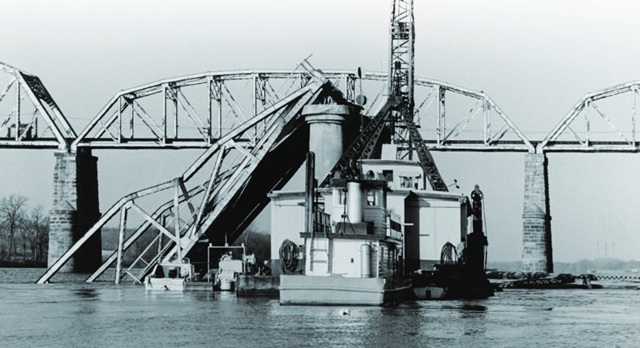
Season4-Episode5에 나오는 또 다른 교량은 미국 교량붕괴사에서 반드시 언급되는 유명한 Silver Bridge다. 공식 명칭은 Point Pleasant Bridge이나 알루미늄 페인트를 사용하여 교량이 번쩍번쩍 빛나는 은빛이라 Silver Bridge라는 명칭이 더 상용되었다. 교량 붕괴로 46명의 사망자가 발생한 대형 참사라 관련한 정보는 인터넷에서 쉽게 확인이 가능하므로 이 교량사고가 갖는 의미에 대해 정리했다.
이 사고가 교량설계 발전에 미친 영향은 ASCE(American Society of Civil Engineers)협회 홈페이지에서 아래와 같이 소개된다.
This incident had a profound impact on the approach used by civil engineers to assess the integrity of bridge structures. The Federal-Aid Highway Act of 1968 initiated the first national bridge safety inspection program in the United States as a direct result of the collapse of the Silver Bridge. This legislation directed the Secretary of Transportation to develop National Bridge Inspection Standards (NBIS) and directed each state to establish an inventory of all bridges on the federal aid highway system (the National Bridge Inventory). Two years later, the Federal-Aid Highway Act of 1970 mandated that all bridges on the Federal-aid highway system routinely undergo a bridge safety inspection in accordance with the bridge inspection standards that had been developed. In 1978 the mandate was expanded to all bridges longer than 20 feet on any public road. (Silver Bridge Collapse and Creation of National Bridge Inspections Standards)
이 사고는 교량의 건전성을 평가하는 토목기술자들의 접근 방식에 큰 영향을 미쳤다. 교량의 붕괴를 계기로, 1968년 연방 고속도로 지원법(Federal-Aid Highway Act of 1968)은 미국 최초의 국가 차원의 교량 안전 점검 프로그램을 도입하였다. 이 법률은 교통부 장관에게 국가 교량 점검 기준(National Bridge Inspection Standards, NBIS)을 마련하도록 지시하였으며, 동시에 각 주 정부에 연방 지원 고속도로 체계에 포함된 모든 교량에 대한 목록, 국가 교량 데이터베이스(National Bridge Inventory)를 구축하도록 규정하였다. 이후 2년 뒤인 1970년 연방 고속도로 지원법에서는 연방 지원 고속도로 체계에 포함된 모든 교량이, 수립된 교량 점검 기준에 따라 정기적인 교량 안전 점검을 의무적으로 수행하도록 규정하였다. 나아가 1978년에는 그 적용 범위가 확대되어, 모든 공공도로에 위치한 연장 20피트(약 6m) 이상의 교량에 대해 동일한 점검 의무가 적용되었다.
교량설계 발전 측면에서 보면 단일 붕괴 사고가 제도적 설계 요구사항으로 전환되고, 기존의 설계(design) 중심에서 유지관리/점검(inspection) 중심으로 패러다임을 확장한 계기가 된 중요한 이정표가 된 사고이다.
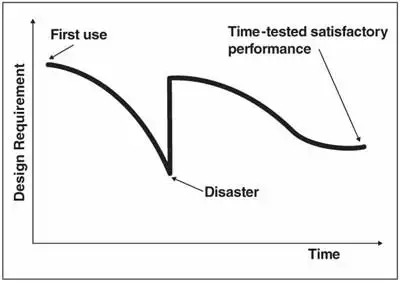
‘교량 설계는 실패를 통해 진화하며, 붕괴는 설계 기준 발전의 트리거(trigger) 역할을 한다’라고 교량설계의 진화를 시간의 경과에 따른 설계요구사항의 상관관계로 설명해 놓은 좋은 글이 있다. 저자는 Minnesota 대학 Theodore V. Galambos 교수이며 글 중 관련 내용을 아래에 정리했다.
먼저, 새로운 형식의 구조물(재료, 구조계 그리고 시공법 등)을 도입할려면 불확실성이 크기 때문에 매우 보수적으로 설계를 하게되어 큰 안전율과 부재 단면 등 설계 요구사항이 상당히 높다. 그러다 공용 중에 문제가 없으면 설계자는 점점 덜 보수적으로 설계하게 되어 안전율 감소, 경제성 추구 등 설계 요구사항이 낮아 지는데 시간이 지남에 따라 설계여유(safety factor)가 소진되고, 예상치 못한 하중, 국부 손상 그리고 시공 편차 발생 시 취약 발생 등으로 붕괴를 한다. 이는 무지해서가 아니라 성공 경험이 누적된 결과로 발생하는 경우가 많다. 붕괴가 발생하면 다시 보수적으로 회귀를 하거나 구조 형식 자체를 부정하는 사회적 여론이 형성된다. 기준 강화, 안전율 증가, 상세 규정 추가 그리고 검사/유지관리 요구 증가 등으로 설계 요구사항은 다시 높아지게 되며, 붕괴된 형식의 구조물을 기피하는 경향이 발생한다. 그러나 사고를 통해 지식이 축적되어 취약 메커니즘을 인지한 상태이므로 초기에 다시 보수적으로 접근을 하더라도 점차 안전과 경제성의 균형점으로 수렴하게 되는데 설계요구 사항은 점진적으로 완화된다.
Silver Bridge 붕괴는 국부적인 손상이 전체 구조물의 붕괴로 직결된 대표적인 사례이다. 이 사고를 계기로, ‘부재는 파괴될 수 있으나 구조 시스템은 붕괴되지 않아야 한다‘는 설계 철학이 본격적으로 인식되기 시작하였다. 나아가 교량의 안전성은 설계 단계에 국한되는 문제가 아니라, 점검,유지관리 등 구조물 생애 전 주기(life-cycle) 관점에서 다루어져야 할 문제임을 분명히 한 중요한 전환점이 되었다.
The outstanding attention to detail exhibited in the accident investigation, especially with regard to the hard evidence of the fractured eyebar, left little doubt that the failure was rooted in a design that inadvertently made inspection all but impossible and failure all but inevitable. (p174)
이 책은 Silver Bridge와 관련하여 많은 양을 할애해서 소개하는데 건설과 관련된 일화도 있어 원문 일부를 옮긴다.
The original design for the bridge between Point Pleasant and Gallipolis was more conventional than the structure that was eventually built. The Baltimore firm of J. E. Greiner Company had determined that by employing the by-then familiar combination of steel-wire cables and a distinct stiffening truss, the bridge could be built for an estimated cost of $825,000. However, when the construction job was advertised, bidding contractors were given the opportunity to propose an alternative design that could be erected for under $800,000. If that could be done, the contractor would receive half of the amount saved. The winning bid was submitted by the American Bridge Company, which had built the Florianóp-olis Bridgeand which put forth the design employing eyebar suspension chains, some of whose links would double as truss members. Parallel pairs of eyebars, each of which was to be two inches thick, twelve inches wide, and as long as about fifty feet, would be linked together bicycle-chain style with steel pins to form the main part of the suspension system. And, as in the Florianópolis Bridge, the steel to be used in the Silver Bridge eyebars was to be also for the first time in the United States-heat-treated to produce a stronger material. Because chain links made of such steel could carry more load relative to their own weight, the bridge itself would be a lighter and thus less costly structure. However, there was one notable difference between the chains of Silver Bridge and those of the Florianópolis. The latter had four eyebars per link, whereas the former had only two. This would prove to be a very significant weakness in the American design. (p154)